
culture
Why Balinese Offerings Are Everywhere
Nusata Editorial · 11 February 2026 · 4 min read
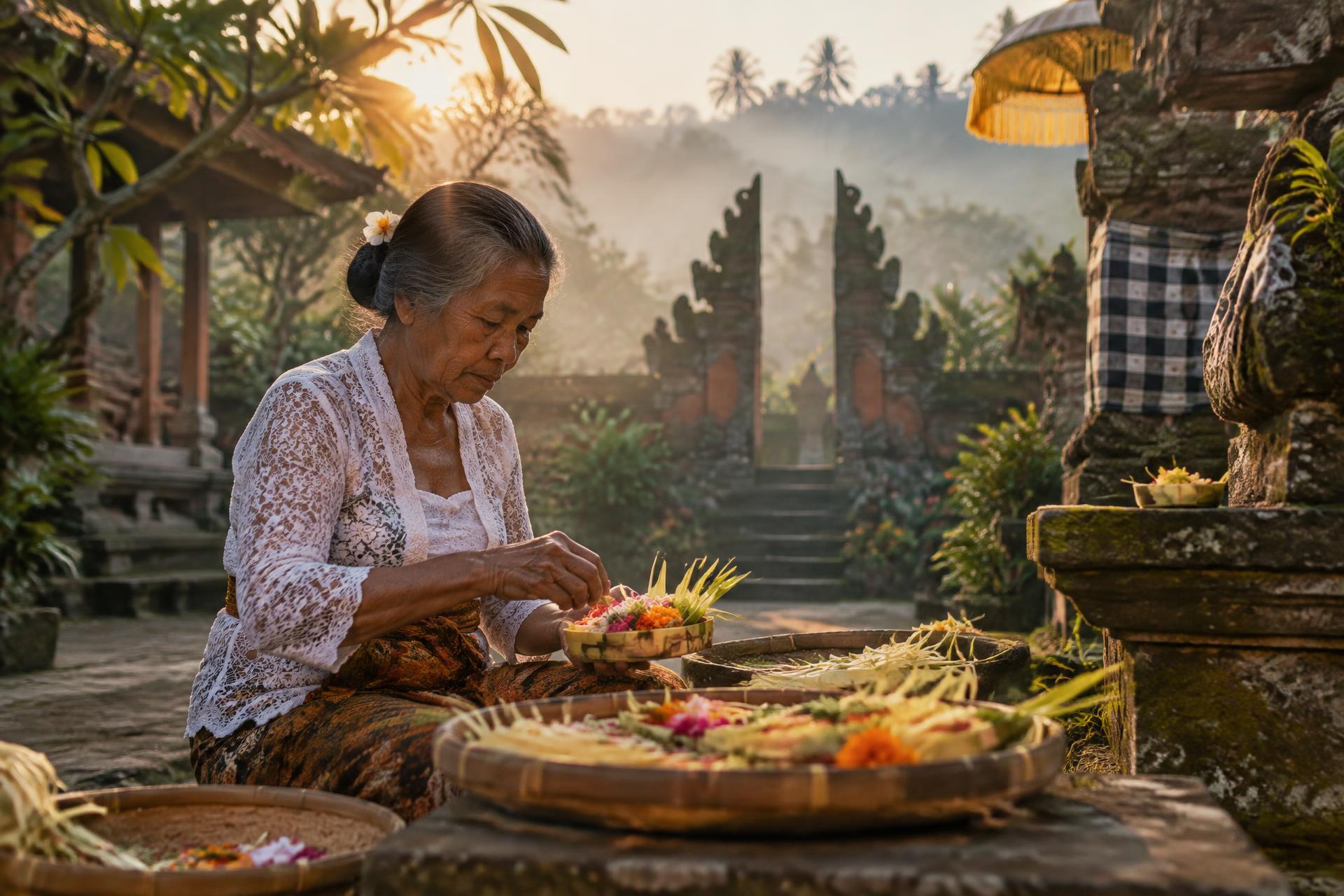
Canang sari sits on shrines, thresholds, motorbikes and shop counters. It is not decoration, and it is not asking for anything.
Walk any Balinese street before eight in the morning and you will step around small palm-leaf trays holding flowers, rice and a burning stick of incense. Most visitors read them as decoration. They are closer to a daily sentence spoken out loud.
Canang sari is an act of thanks, not a request. The tray is assembled by hand each morning, the flowers placed by colour and direction, and the essence — not the object — is what is offered. That is why yesterday's offering can be swept away without insult, and why a new one appears in its place.
The work is real work. A household may make dozens of offerings a day, more before a temple anniversary. When you learn to fold the leaf yourself, the first thing you understand is how much of a Balinese day this occupies, and how quietly it is done.
The practical guidance for visitors is simple: never step over an offering placed on the ground, walk around it, and do not move one for a better photograph.
Experience this
Making Canang Sari With a Village Family
Ubud, Bali
Learn to fold palm leaf and place flowers by direction and colour — the daily language of Balinese gratitude.